Why We Give

Why We Give

Every one of us has a story.

For some, it's the doctor who found the answer when no one else could. For others, it's the nurse who stayed a little longer, the life-saving surgery that changed everything, or the compassionate care that brought comfort during life's most difficult moments.

At University Hospitals Kingston Foundation, we see every day how generosity changes lives. Every gift—large or small—helps ensure that Kingston Health Sciences Centre and Providence Care can continue providing exceptional care close to home while serving more than 650,000 people across southeastern Ontario.

People from across the region come to Kingston for specialized care they can't receive in their own communities—from heart and brain surgery to stem cell transplants, advanced cancer treatment, life support, cutting-edge diagnostic imaging, and expert palliative care. Behind every one of these moments is a donor who chose to make a difference.

Giving is deeply personal. It's inspired by gratitude, hope, remembrance, and a desire to help others experience the same exceptional care that touched our own lives or the lives of those we love.

The stories below are just a few of the many reasons people choose to give. While every journey is unique, they all share one thing in common: a belief that together, we can help ensure the very best care is here for our families, friends, neighbours, and future generations.
Willem

Willem

When Willem steps on the track in Sydenham this October, there will be no starting gun, no competitors and no medal waiting at the finish line. Instead, what will drive him forward, lap after lap, is something far more powerful. “This is about supporting the tiniest members of our community.”
Willem

Willem

When Willem steps on the track in Sydenham this October, there will be no starting gun, no competitors and no medal waiting at the finish line. Instead, what will drive him forward, lap after lap, is something far more powerful. “This is about supporting the tiniest members of our community.”
Donate Now

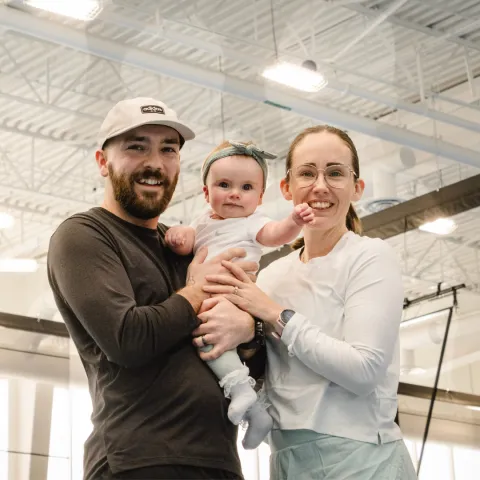
When Willem Sagriff steps on the Point Municipal Park track in Sydenham on October 3, there will be no starting gun, no competitors and no medal waiting at the finish line. Instead, what will drive him forward, lap after lap, is something far more powerful.

The 27-year-old Kingstonian will be focused on one goal; running 100 kilometres to raise funds for the Neonatal Intensive Care Unit (NICU) at Kingston Health Sciences Centre (KHSC), a place that forever changed the way he sees gratitude, vulnerability and resilience.

Willem was inspired to help after he and his wife welcomed their daughter in June 2025.

“Our room was just past the NICU, and I had a lot of time to sit there and think about how lucky we were that our baby was born healthy,” Willem recalled.

This planted the seed for what would become an extraordinary physical and mental challenge.

An avid runner, Willem began setting ambitious running goals several years ago after what he describes as a “wake-up call” run with his wife Liz (then girlfriend). They went for a short two-kilometre run and Willem was gasping for air while Liz was completely fine. 

The realization hit hard. The fitness that he took for granted in high school was gone. “It really bugged me, and it pushed me to get serious about my fitness.”

Since then, Willem has completed many long runs and currently trains five days a week with added strength training sessions. Last year, he tested his limits by attempting to run the 104 kilometre Cataraqui Trail, but his body gave out at 75 kilometres.

“Running 100 kilometres has always been a goal in my head,” he said. “I know exactly what went wrong (on the Cataraqui Trail) and how to correct it. The strength training has made a huge difference, both physically and mentally. I’m very confident in my fitness abilities for October.”

Keith & Kelly

Keith & Kelly

From joining the Paired Kidney Donation Program, to undergoing a life-saving kidney transplant, recovery, and beyond Keith and Kelly understood first-hand the impact of excellent medical care. That's why when Kelly was named CFL Fan of the Year, she knew she wanted to use her platform for good.
Keith & Kelly

Keith & Kelly

From joining the Paired Kidney Donation Program, to undergoing a life-saving kidney transplant, recovery, and beyond Keith and Kelly understood first-hand the impact of excellent medical care. That's why when Kelly was named CFL Fan of the Year, she knew she wanted to use her platform for good.
Donate Now

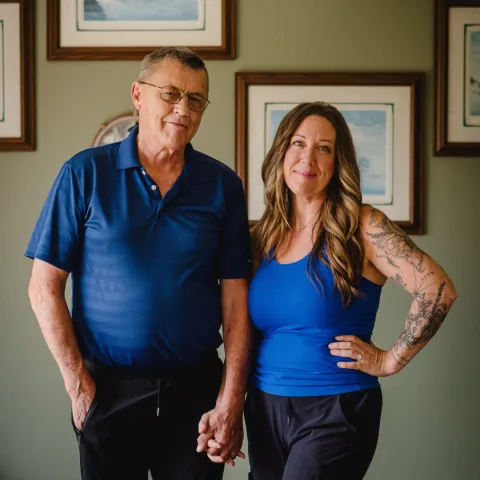
Kelly Hallett was stunned when she was named the CFL Fan of the Year. Despite living in Mallorytown, Ont., Kelly’s passion for the Winnipeg Blue Bombers and her incredible personal story won over the voters.

But for Kelly, the honour is more than just a recognition of her devotion to football—it is an opportunity to give back.

Part of the honour of being named CFL Fan of the Year is getting the Grey Cup for one day. So, on April 25, Kelly brought the iconic Grey Cup to Kingston for a special fundraiser supporting the Living Kidney Donation program at Kingston Health Sciences Centre (KHSC). It was a full-circle moment, marking the one-year anniversary of her husband Keith’s life-saving kidney transplant.

“This wasn’t just my story or Keith’s story,” said Kelly, a 47-year old hair stylist. “This was a journey we took with an entire team of incredible health-care workers and I knew I had to find a way to say thank you.”

Kelly and Keith’s journey began in 2017, when a foot ulcer as a result of Keith’s diabetes spiralled into a medical crisis. While doctors worked to save his leg, his kidneys began to fail. By the time they realized a transplant was necessary, his kidney function had dropped to 15 percent.

“I remember when he came home and said he needed a transplant. He told me he needed a donor with A-positive or O blood type,” Kelly recalled. “I donate blood regularly, so I knew I was A-positive. Right away, I thought, ‘Okay, I’ll get tested.’”

Though she was a blood match, further testing showed that her kidney wasn’t an ideal tissue match for Keith. But instead of giving up, Kelly entered the Paired Kidney Donation Program, which allows living donors to give their kidney to a compatible stranger in exchange for their loved one receiving a better match.

“For me, it wasn’t about who got my kidney—it was about making sure Keith got the best kidney Keith Francis and Kelly Hallett possible,” she explained.

In April of 2024, Keith received his transplant. A month later, Kelly followed through on her promise, donating her kidney to a recipient in need.

In gratitude, she used the fundraiser as a platform to raise awareness about the importance of organ donation and the incredible impact of living donors.

The event took place at the Merchant Tap House restaurant in Kingston and raised more than $21K that went directly to UHKF to support kidney transplant services at KHSC.

Kelly also brought the Grey Cup to KHSC as a way to thank health-care workers.

“The hospital staff were our rock through this entire process,” Kelly said. “They became like family. This fundraiser is about giving back, but it’s also about inspiring others to consider organ donation. If one person signs their donor card because of this event, it’s a victory.”

Corey

Corey

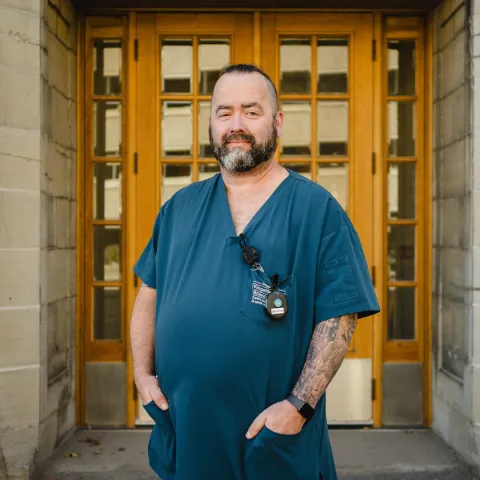
Two years ago, Corey Dunn was lying in a hospital bed not knowing if he would ever walk again. Thanks to the expert care of KHSC Neurosurgery. Back on his feet, Corey decided to transform his recovery into a journey of gratitude by hosting a pledge walk fundraiser to help pay it forward.
Corey

Corey

Two years ago, Corey Dunn was lying in a hospital bed not knowing if he would ever walk again. Thanks to the expert care of KHSC Neurosurgery. Back on his feet, Corey decided to transform his recovery into a journey of gratitude by hosting a pledge walk fundraiser to help pay it forward.
Donate Now

Corey Dunn was lying in a hospital bed in the summer of 2023 not knowing if he would ever walk again. Now healed and feeling much better, Corey has literally taken steps to help others who are facing similar health issues. 

In September and October 2025, Corey transformed his recovery into gratitude, raising $4,110 by walking 570 kilometres (10 kilometres for each of the 57 days he spent in hospital) for the Kingston Health Sciences Centre (KHSC) Neurosurgery Department. 

It all started in August 2023. After months of worsening back pain, Corey suddenly lost feeling in his legs and was rushed to the Emergency Department at KHSC. Doctors discovered a severe spinal infection that had eaten away at his vertebrae, leaving his spinal cord compressed.

“I describe it as a beaver notching out of a tree,” Corey recalls. “It ate away at part of the bone of the spine, and once that notch was made, a cyst popped out and pinched off my spinal cord, which is how I lost the feeling.”

He underwent surgery in which two metal rods and 12 screws were inserted in his back. After his hospital stay, Corey spent many more months in rehabilitation at Providence Care Hospital. The 43-year-old—who had been training for a strongman competition and once pulled a fire truck for a charity fundraiser—now had to relearn how to stand, balance and take his first steps again.

“That first month I was in the hospital right after surgery, I didn’t know if I was going to be able to walk again until I stood up for the first time at Providence Care Hospital and took a couple of steps,” Corey says.

Corey, who works as an Environmental Services Attendant at KHSC’s Hotel Dieu Hospital site, decided to give back in honour of the health-care professionals who supported him throughout his recovery.

“I wanted to do a fundraiser. I didn’t have it easy, but I had it easier than other people,” Corey says. “So, I figured if me doing this makes what I went through easier for the next person, then it’s worth it.”

Walking is still not pain-free for Corey. He continues to experience constant nerve pain and knows his mobility will never fully return. But instead of focusing on what he lost, Corey chooses to focus on what he gained: the chance to walk again, and the opportunity to help others.

Julia & Johnny

Julia & Johnny

Julia was praying for a miracle when at 23 weeks pregnant—the time she was supposed to be picking baby names—doctors found a 9cm tumour in her heart. Thanks to expert care, Julia underwent open-heart surgery during her second trimester and is regaining her strength through cardiac rehabilitation.
Julia & Johnny

Julia & Johnny

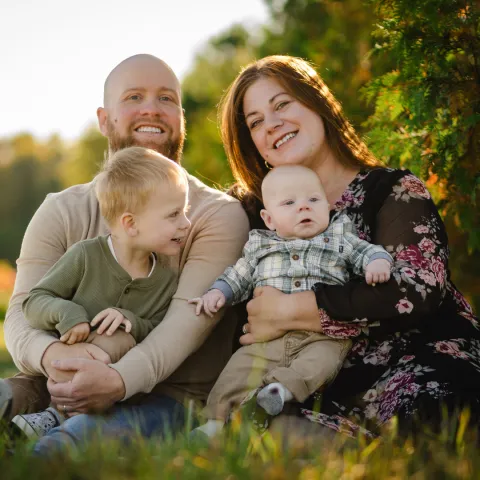
Julia was praying for a miracle when at 23 weeks pregnant—the time she was supposed to be picking baby names—doctors found a 9cm tumour in her heart. Thanks to expert care, Julia underwent open-heart surgery during her second trimester and is regaining her strength through cardiac rehabilitation.
Donate Now

Last New Year's Day, she was praying for a miracle.

This year, she gets to hold one in her arms—because of the care, compassion and skill that saved them both.

It all began in the Emergency Department at Kingston Health Sciences Centre (KHSC), where the words "heart attack" and "tumour" stopped her world. She was 23 weeks pregnant—supposed to be picking baby names, not fighting for her life.

Doctors found a nine-centimetre tumour in her heart. Pieces had broken off, sending fragments through her body. Every heartbeat felt dangerous.

In those first moments, dark thoughts crept in—Would her baby survive? Would she? But she forced herself to breathe, to push the fear away. If there was even a sliver of hope, she was going to hold on to it with everything she had.

And somehow, they made it through. Surgery happened—and there were tears. But even after that, there was still a long road ahead. She spent nearly a month in hospital while her care team monitored everything—her heart, her baby and her recovery. Each day was a mix of relief and fear, gratitude and exhaustion.

When the day finally came, it felt like the world stood still. After everything she had endured, hearing her baby's first cry was the most beautiful sound imaginable. She remembers holding her breath until she heard it—and then she couldn't stop crying herself, this time tears of relief, gratitude and joy. The room was filled with doctors and resident doctors who had been with her every step of the way, and in that moment, it felt like everyone was celebrating together.

But recovery didn't end there. Because of everything her body had endured, she needed more time—more care—to fully recover. That's when she began the Cardiac Rehabilitation Program at Providence Care Hospital. That's where determination took root.

She had to relearn the simplest things—how to believe in her own strength, how to trust her body again. Progress was slow, but every small victory mattered. The therapists pushed her, encouraged her and celebrated each milestone as though it were their own.

There were days she wanted to give up from exhaustion, but never once was she left to face it alone. Step by step, her strength returned—and with it, the life she'd been fighting so hard to reclaim.

It was incredible—from the surgeons who saved her life to the porters who smiled as they wheeled her through the halls. Every person, from dietitians to housekeeping, carried a quiet kindness—an unshakable belief that things could get better. No question ever went unanswered; if they didn't know, they'd find someone who did. Even when the answers were hard, their compassion never faltered. Somewhere between the steady footsteps of nurses and the soft hum of machines, hope began to feel real again.

Now, as she moves through this season of firsts—her first quiet mornings without the sound of monitors, her baby's first laugh, and her first Christmas at home as a family of four—she carries their kindness with her. It's in every breath, every heartbeat and every small miracle they get to celebrate together.

It's hard to describe what it feels like to hold a baby for the first time—the sheer disbelief, the overwhelming gratitude, the quiet realization that somehow, life has been handed back to you. Today, when she looks down at that small, perfect face, she remembers everything it took to get there: the skill, the compassion and the sleepless dedication. Every step of her recovery was made possible by the incredible care she received at KHSC and Providence Care—right here, close to home.

These hospitals and health-care sites are more than buildings; they're places where expertise meets heart, where neighbours care for neighbours with quiet strength and unwavering kindness.

And it's because of donors like you—people who choose to believe in care for complete strangers—that stories like hers are possible. Your generosity helps ensure more patients and families can receive life-saving care close to home, when they need it most.

Please support our hospitals this holiday season by making a donation through University Hospitals Kingston Foundation (UHKF). Your impact will be doubled because every dollar donated before Dec. 31 will be matched—up to $100,000—by a group of generous Angel Donors who wish to remain anonymous.

Thank you for making this a place where hope truly lives close to home—and for giving more families the chance to celebrate life's precious firsts together.

Dave & Marianne

Dave & Marianne

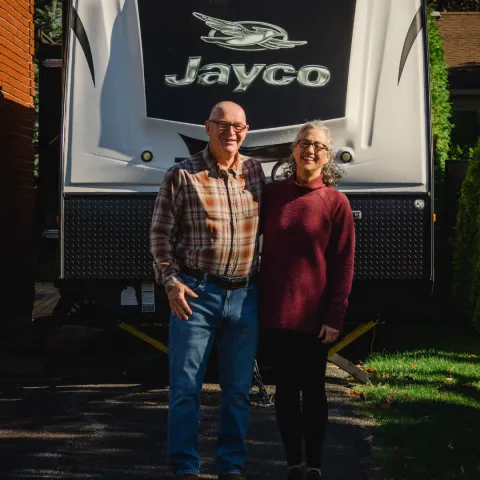
In January 2023, newly retired 65-year-old Dave Thompson was ready to hit the open road. With his wife and their RV, the world felt full of adventure—skiing in Quebec, snowshoeing through snowy trails, and exploring the great outdoors.
Dave & Marianne

Dave & Marianne

In January 2023, newly retired 65-year-old Dave Thompson was ready to hit the open road. With his wife and their RV, the world felt full of adventure—skiing in Quebec, snowshoeing through snowy trails, and exploring the great outdoors.
Donate Now

Retirement was supposed to be a time of freedom and excitement. But soon, a warning sign appeared—he struggled to keep up on walks with his wife. Shortness of breath was subtle at first, but it marked the start of an unexpected detour.

A visit to his family doctor led to a cardiology referral, and in June 2023, Dave received the news: he had severe mitral valve regurgitation, which is when the heart’s mitral valve leaks significantly backward into the left atrium, forcing the heart to work harder. Active days would have to pause, and the path ahead seemed uncertain. Yet, with the support of skilled medical professionals and donor-funded technology, a new route emerged.

After a series of tests, Dave received hopeful news—he was a candidate for minimally invasive mitral valve repair.

Unlike traditional open-heart surgery, this advanced procedure could be performed through a small side incision, allowing for a much faster recovery. Dr. Holly Mewhort, one of only a few surgeons in the region trained in this technique, became his trusted guide through the process.

On February 8, 2024, Dave underwent surgery. The operation went smoothly and a week later he left the hospital, beginning a careful yet determined recovery. Unexpected leg pain and nerve issues made mobility challenging, but with support from physiotherapists and the surgical team, he regained strength and independence. By spring, he was walking trails again, and by summer, skiing and RV adventures were back on the agenda.

Reflecting on his experience, Dave emphasizes the role of donors in making this journey possible. From advanced diagnostic equipment to minimally invasive surgical tools, each donation helped create the conditions for a faster, safer recovery. For Dave, donor-supported care meant returning not only to life but to the adventures that make life meaningful.

Dr. Boyd

Dr. Boyd

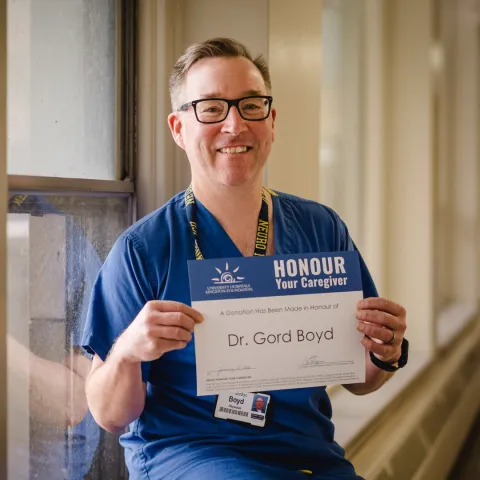
“I am deeply grateful to donors like you for investing in better care and a healthier future for every patient we serve," shared Dr. Gord Boyd, neurologist and critical care physician at KHSC, who has seen firsthand how donors transform patient care.
Dr. Boyd

Dr. Boyd

“I am deeply grateful to donors like you for investing in better care and a healthier future for every patient we serve," shared Dr. Gord Boyd, neurologist and critical care physician at KHSC, who has seen firsthand how donors transform patient care.
Join YGK!

When a loved one is on life support and the end is near, there is no easy way to say goodbye. But in those final, heart-wrenching moments, some families choose to turn their pain into purpose. 

Organ donation does not ease the loss—but knowing their loved one helped save other lives can bring a sense of meaning amid the sorrow and give comfort to a grieving family. 

Unfortunately, not every organ donation goes as planned. Once life support is withdrawn, a person may continue to live for minutes, hours or even days. Medical teams are on standby but sadly, there are situations when the timing falls outside the window for organ donation to proceed.

“If the patient doesn’t pass within approximately 30 minutes after life support is withdrawn, the liver can no longer be used for transplantation, and the liver transplant team will leave,” says Dr. Gord Boyd, a neurologist and critical care physician at Kingston Health Sciences Centre.

One-third of consented DCD (donation after circulatory death) candidates do not proceed as they do not die within established time limits for organ viability.

This heartbreaking reality is something health-care professionals have been striving to change.

With the high demand for organs and long wait times, every transplant matters.

That’s where the Donation Advisor program came in. 

This innovative artificial intelligence program is designed to help improve the success rate of organ donation by using patient’s clinical information to better predict the time of death. The goal is to ensure more donors can successfully give the gift of life, preventing missed opportunities and reducing the secondary loss experienced by families who had hoped their loved one’s legacy would live on through donation.

Dr. Boyd has seen firsthand how difficult and complex organ donation can be. 

“There are many factors that can make or break an organ donation,” says Dr. Boyd. “Donation Advisor has the potential to streamline the process, ensuring that patients who wish to be donors can actually follow through with that wish.”

To help fund this groundbreaking initiative, the Dr. Boyd pitched his funding need to the YGK Healthcare Champions to see if they would help fundraise for this impactful project. Thus, the first annual Banding Together fundraising concert took place, with $33,000 being raised for the initiative. 

The event featured Old Docs New Tricks, a band composed entirely of Kingston doctors with a passion for music.

Dr. Boyd, who plays in the band, not only got to have his project benefit from donor support, but also got a center stage view of how community can come together.  

“I am deeply grateful to donors like you for investing in better care and a healthier future for every patient we serve.”